


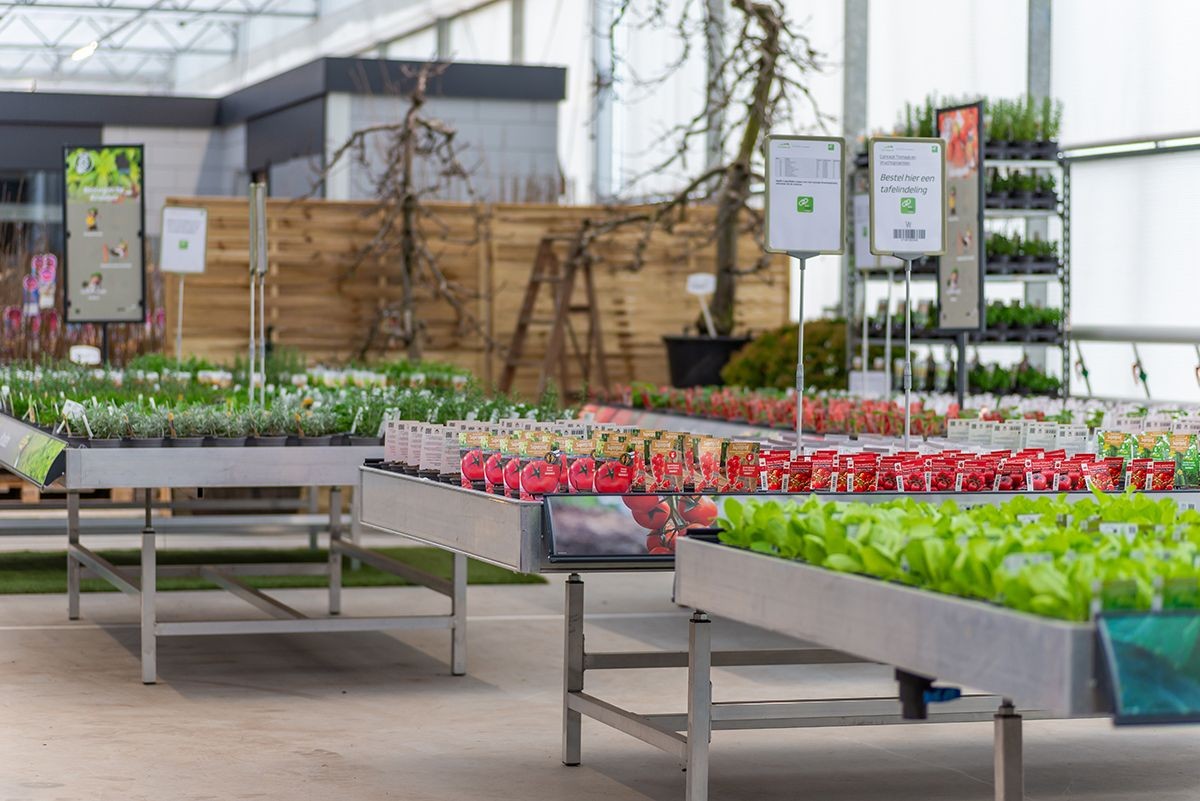
At Plant Collect, you can find vegetable plants, herbs, and strawberry plants for your edible garden.
From February through September, we offer a wide range that evolves with the season. In January, we start with lettuce, parsley, and robust herbs such as thyme and rosemary. Then follow strawberry plants, cabbages, celery, and other vegetables, while the herb selection also expands. From the end of March, when the season for fruiting vegetables begins, our range is at its largest.
We believe it is important to offer a broad and diverse assortment. The vegetable garden should be a place to experiment with varieties, shapes, and flavors that are hard to find in supermarkets.
Sustainable
Sustainability is central to our supplier.
- Energy: Several years ago, six hectares of willow and local greenery were planted. Every three years, this wood is pruned and chipped to be used for heating the greenhouses, making them largely CO₂-neutral.
- Water: All water falling on the greenhouses and container fields is collected, purified, and reused.
- Materials: The pots are made from recycled plastic. Used pots are pressed and recycled again.
Strong Plants Through Natural Cultivation
Our supplier believes that preventing pests is better than fighting them. Therefore, they apply the principles of organic cultivation as much as possible. The basic rule is simple: everything that leaves the company must be edible and healthy. Pests are avoided by growing plants slowly and carefully, resulting in strong, well-hardened plants. They combat pests using biological agents such as predatory mites and parasitic wasps. Soil improvers are used to stimulate root development.
By selecting varieties that are as disease-tolerant as possible, they reduce the risk of diseases and pests, both during cultivation and later in the vegetable garden.
The edible plants are specially selected for the vegetable garden, with taste as the absolute priority. They must not only be tasty but also strong and easy to grow. In addition to variety selection, the cultivation method plays a crucial role. By growing plants slowly and properly hardening them, they experience less stress in the garden center and grow more easily in the vegetable garden. Herbs that are not forced also develop more aroma.
The Vegetable Garden of Tomorrow
To better withstand long, dry periods, diversity in the vegetable garden is essential. The “old vegetable garden” is increasingly being replaced by a more diverse garden. Underplanting beneath larger plants, for example with herbs, better protects the soil against drying out. Different species planted together can also protect each other from diseases and pests. For example, basil planted among tomato plants helps repel insects.
Due to warmer summers, they see that fruiting vegetables such as tomatoes, peppers, zucchini, and cucumbers produce much better harvests than before. For many of these varieties, a greenhouse is no longer even necessary. This explains why these fruiting vegetables have become so popular in recent years.


Plant Collect B.V.
Plant Collect has been the supplier of a complete range of garden and houseplants, including bedding plants, for over 20 years.


